Finding Morels in Riparian Zones
Updated: Mar 5
Types of Morels
In the Pacific Northwest we generally group morels into 3 categories: Fire Morels, Natural Black Morels, and Blonde Morels. Inside each of these groups are several specific species of morel. To compare and contrast the most commonly found species in our are see Morels.
These categories group the morels based on 2 features: cap color and fire association (many morels only grow in areas impacted by forest fire), but they can be further categorized by their chosen habitats. This article is the first in a short series of blog posts where we will learn about specific habitats to seek out when hunting Morels. Knowing their favorite hiding places will help you increase your chances of success this spring!
What's a Riparian Zone?
Riparian zones are the transitional areas between aquatic zones (like streams or rivers) and upland (or dryer) zones. I find these areas most frequently on the Western slopes of the Cascades or on the Olympic Peninsula, and while they likely exist East of passes I find hunting Fire and Natural Black Morels more fruitful there. To find public land you're allowed to forage mushrooms on, see my summary of parks and their rules/limits. These riparian areas typically have sandy soil that stays wet most of the year making it the perfect home for one morel's favorite tree: Cottonwood.

Learn how to identify all the Pacific Northwest native trees that will lead you to tasty mushrooms in our Companions Section.
When to Look For Riparian Area Morels?
All morels are most commonly found in the spring, after any snow has melted and the nighttime ground temperature consistently stays at least 50°F. The conditions for morels might only be right for a few weeks in each area, but the area of 'rightness' moves from lower elevations in the early spring to higher elevations as the season progresses. If you're not finding them where you are, consider moving up the mountain or closer to sea level depending on the temperature in your local area. There are a few ways to predict when that will happen - so you can plan your trips in advance - and to confirm once you arrive.
Tools for predicting ground temperature:
Early in the spring soil temps tend to be lower than air temps, when day time highs start to hit 60°F the ground is likely warming to 50°F or higher. Remember that wetter soil warms slower.
A farmer calculation: Take the high and low air temperatures for 3 days in a row. Calculate the daily average for each day, then average those 3 daily averages. A 3-day average nearing 50°F indicates the soil temperature will likely match.
Soil Temperature App is a newer tools that includes a 5 day soil temperature forecast
GreenCast is a resource for lawncare professionals that provides detailed ground temperature data current and past
NOAA provides detailed data about soil temps in a downloadable format, but be prepared to do the analysis yourself
I am not affiliated with nor can I vouch for any of these tools, internet at your own risk!
Tips for confirming the ground temperature is right:
There are a lot of factors that influence soil temperature: sun exposure, tree cover, ground cover, moisture, wind and air temperatures, etc. You can visually confirm you're in an area that's warm enough by looking out for these common signs:
Trillium flowers also bloom in 50°F soil, when you see their white blooms you know you're in the right place.

Cottonwood trees will be covered in dangling Catkins, these are the flowers of the tree and come in a reddish flowery version (male) or greenish strings of bulbs (femail) that will be swelling in preparation to release fluffy seed pods in the late spring.

The understory (the plants that grow close to the ground between trees) will be reaching 1-2 feet tall, these plants will be sparse enough to allow sunshine through for morel growth but will still be difficult to see through. Take your time, gently move the undergrowth aside to peer through.
Which Morels Prefer Riparian Zones?
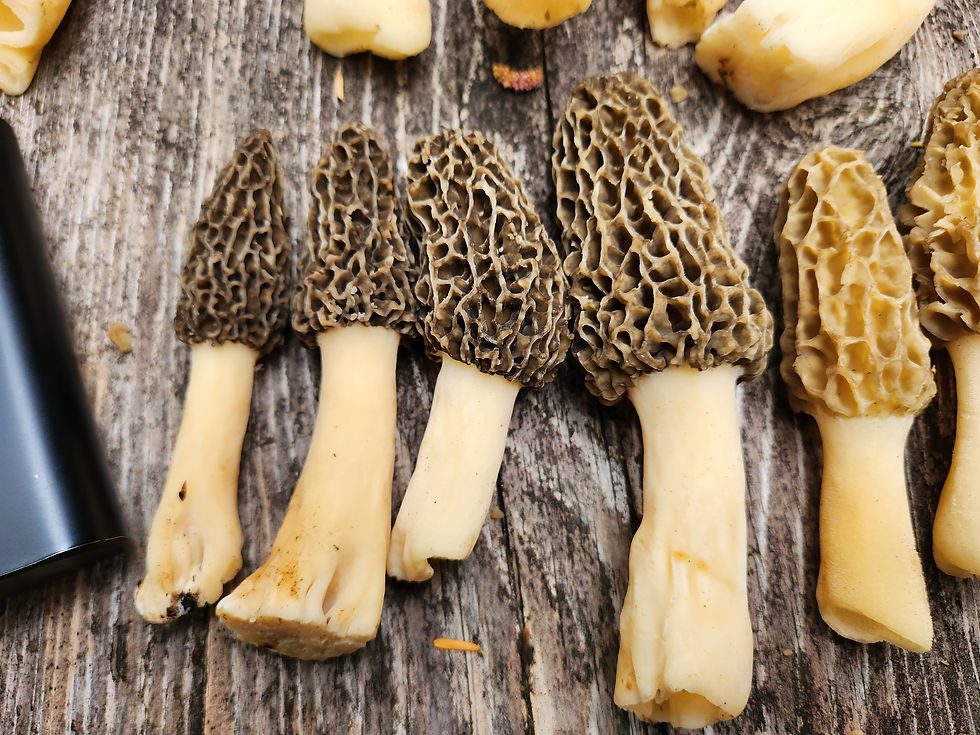
Morchella americana, Morchella brunnea, and Morchella prava are the most common morels found in riparian zones in the Pacific Northwest, and the two mushrooms are almost impossible to tell apart. Both are characterized by their blonde to greyish brown caps, irregular pits (never arranged in vertical rows), and cap that fuses to the stem without a notable depression at the join. Learn how to distinguish Morels from poisonous look alikes.

Enjoying Morels
Morels must always be cooked over medium-high heat before consuming because they can contain toxins when raw. Always use caution when eating wild foraged mushrooms, because you cannot control the environment or substrate they are growing in. Reduce your chances of getting sick by following the Safe Eating Guidelines every time.
These blondes have a milder flavor than black morels and should be paired with mild flavors so as not to lose the nutty taste. They can be cleaned by soaking in lightly salted water and are typically large enough to encourage stuffed mushroom recipes, like this one (but stick to the pine nuts and butter to avoid losing the mushroomy flavors) https://www.motherearthnews.com/real-food/stuffed-morel-mushrooms-zerz1610zfis/.
If you are ever so lucky as to have more than you can eat, store by freezing or drying.
Happy Hunting!


Comments